
|
Monday, 16 January 2012 12:51 |
|

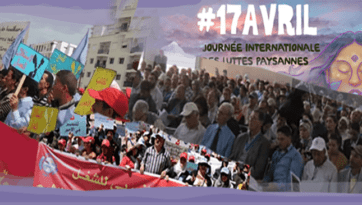
(Jakarta, 12 January 2012) A large rally demanding agrarian reform and people’s rights shook Jakarta and 27 other provinces all across Indonesia on January 12. At least 7 thousands of people marched from the Supreme Court to the Presidential Palace and ended up at the House of Representatives.
47 organisations joined in what they called the “Joint Secretariat of the Indonesian Movement for Recovering People’s Rights’. They declared resistance and denounced land grabbing facilitated by the SBY-Boediono regime throughout Indonesia.
This huge coalition, led by Serikat Petani Indonesia, various other peasant movements, fisher folks, workers, indigenous people, women, youth, students, village governance groups and NGOs, rattled the street in a fight against recent land grabbing cases in Mesuji and Sape. Both cases involved casualties among the populations perpetrated by corporations and the police.
The current cases in Mesuji and Bima that became public late 2011, show that the police did not hesitate to kill people who resist land grabbing. The National Police has clearly and openly become a mercenary force for plantation, mining, and forestry companies.
The concrete proposals from the protesters were to immediately implement Agrarian Reform and Village Reform for Ecological Justice.
|
|
Read more...
|
|
Friday, 13 January 2012 12:55 |
|
JAKARTA. At the end of 2011 one horrible news struck Indonesia. A total of 30 Mesuji farmers in Lampung and South Sumatra fell victims of violence due to conflicts with corporations. Violations have happened for a long time, but had remained hidden especially by local authorities.
According to Henry Saragih, Chairperson of the Indonesia Peasant Union (SPI), deaths of farmers are caused by the increase in agrarian conflicts all across Indonesia. SPI recorded 20 death (from 120 cases of agrarian conflicts) in 2011.
Meanwhile data from the National Commission of Human Rights (Komnas HAM) said that out of 6,000 cases of violations occurring each year, 1,000 are committed by plantation companies. Many conflicts between companies and communities have happened since the New Order era.
Henry also lashed on Plantation Law No. 18/2004. "The Law provide a very strong preference to companies to grab land from the people. Some articles in it also provide space for companies to continue to criminalize farmers and indigenous people,"
|
|
Read more...
|
|
Friday, 13 January 2012 11:08 |
|
Chavannes Jean-Baptiste is the Executive Director of Mouvement Paysan de Papaye (MPP), an Haitian member of La Via Campesina interviewed on December 11, just after the closing of COP17.
JC: What are you doing here Durban during United Nations COP17?
Chavannes Jean-Baptiste: I am here with the Via Campesina delegation in Durban. La Via Campesina is promoting food sovereignty as the way not only to resolve the food crisis, but also the climate crisis. There are a lot of studies to show that peasant agriculture, agro-ecological production, can cool down the earth. Around the world, La Via Campesina is fighting against industrial food production, which is responsible for more than 50 percent of global greenhouse gas emissions. We are fighting against agrofuel production, and agribusiness consortiums like Monsanto that are destroying the soil, and the biodiversity with pesticides and GMOs, and killing native seeds in developing countries. A lot of peasant organizations and NGOs came to Durban to say no to REDD, no to agriculture in the negotiations, and no to the carbon market.
|
|
Read more...
|
|
Thursday, 12 January 2012 19:14 |
European Coordination Via Campesina - PRESS RELEASE -BRUSSELS, January 11th
On January 7th, 2010 the African workers employed to harvest citrus fruit in Rosarno, Italy expressed their anger.
This legitimate revolt was triggered by racism, unacceptable working and housing conditions and unpaid wages. It shocked public opinion by highlighting the situations of unsustainable exploitation of the workers.
The mobilization of African workers has increased solidarity between the small-scalefarmers who no longer have any income and farm workers. It has also created favorable conditions for the self-organization of the workers. This action has led to the granting of residence and entreprenreurship permits in Rome, and in Nardo in August 2011 to the longest ever seasonal workers' strike in Italy to demand better working and pay conditions.
For years the farmers' unions that are members of the European Coordination Via Campesina and associations or agricultural workers' unions have been struggling together to impose the acceptance of peasant farming, agro-ecological practiceand solidarity. (This is the specific case of the campaign "SOS Rosarno" which involves migrant workers, small-scale farmers whose livelihoods have been destroyedby supermarkets, small retailers and consumers).
|
|
Read more...
|
|
|